The photocopy and the handProposition: the hand is an object, in the same way in which the photocopy is an object. If this premise is consistent, it is then possible to propose that the text—for there is nothing more than text in the paper—is either a relation or an extension. A relation: inasmuch as it describes a transition between an object and another, which amounts to saying, it assigns a causal relation (the hand) and an effect (the copy). Here, the order of the words is crucial. The action of taking, reading, grabbing, letting go of—action as a raw fact—is what specifies the situation. Here reading appears as an opposition or as subordination: of text and/to action; of action and/to the hand; of the hand and/to the copy (and all their possible permutations). In these relations, the hand is the central unity, the common measurement, the invariable principle. This is also the terrain of technique, virtuosity, aggression, creation, authenticity, originality, domination, exemplary heroism, activity and mastery. Mastery, as the subordination of all functions to a self justifying act. There is not much more to add to this causal game. It is interesting though, to recall the etymology of the word emancipation, literally meaning separation from a grabbing hand— separation from the hegemony of an original act. Reading is a hegemony, the hegemony of the reader as author and origin. An extension: the hand supplants, it becomes a substitute for something else, an ambassador of the copy, a mediator. The relation between causes and effects becomes complicated. The regime of activity in which the casual order occurs is disrupted. The extension becomes the impersonation of an effect. Reading here does not appear as glorified or deified, instead it occupies a parallel regime of action: the death of the author and the birth of the reader are metaphors that elevate the mastery of the text over experience; subordinating the text to a mortal and a maternal order, respectively. The proposition ‘the hand is an object, in the same way in which the photocopy is an object’ implies that reading is developed in conjunction, extensively, as a mediation. Reading becomes another material. The hand matters, the copy matters. The copy matters, the hand matters. The object in itself is an extension of something else, of a subrogate group of copies and modifications, operations and variations. In short, it effects an indistinction between causes and effects. Materially, it occupies the same space as other series of objects—materially meaning here that ideas are not opposed to matter, that they occupy the same plane of consistency. Ideas are at once matter and material. The reader is not a master, nor is the boss ruling other actions. The reader is an actor, a functionary, an operator. Here appears the possibility for a mediation and displacement of the activity of the word object, a modulation: object = objective A material fact, a concretion. Not an activity that is subordinated to another activity. The infinite repository of irreducible gestures and actions that is the hand induces a certain shortsightedness—one of perceiving in excess: it induces a figure of mastery as a necessity. If the hand is an object, it becomes a function of activity and a subrogate of such activity. Abilities, techniques or qualities here are able to acquire less meaning. The hand has been deskilled by the photocopy, the photocopy deskilled by the hand. The text has been transformed. It only occurs in relation to: it occurs at once as object and as objective. | 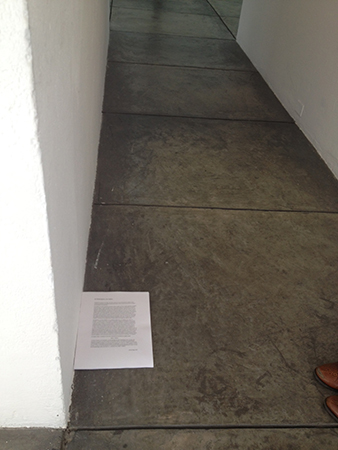 La fotocopia y la mano, Manuel Ángel, El año pasado, 2012 |